

Tesfaye Bekele founded Suke Quto in the aftermath of a series of wildfires that destroyed huge swaths of forest in the highlands of Guji Zone. At the time, Ato Tesfaye was a recent graduate working for Ethiopia's national forestry service. Witnessing locals replanting the razed forestland with sun-loving monoculture crops like corn and wheat, he began campaigning for coffee as an alternative - a native species that could be cultivated as a cash crop, but still grown under existing forest cover.
Initially Tesfaye's efforts were met with reluctance. This particular part of Guji was known for its mineral deposits and livestock, but it was not an established region for coffee production. To demonstrate that coffee could be grown profitably, and in harmony with the natural environment, Tesfaye left his job with the government and dedicated himself fully to Suke Quto.
Over the last 25 years Suke Quto has grown into a major operation with full vertical integration. A plant nursery cultivates and distributes seedlings to neighboring farms in an effort to encourage additional forest conservation through coffee cultivation. Two processing stations - one for fully washed coffees, one for naturals - support the farm and its nearly 300 outgrowers in postharvest processing. And as of this year, a newly-built dry mill in Ethiopia's capital of Addis Ababa provides state-of-the-art milling, allowing Tesfaye to retain complete control over quality from start to finish.
Perhaps most impressive though is the sheer magnitude of Suke Quto Farm - two plots of land, Suke Quto 1 and 2, occupy 742 hectares of highland forest. (This is more than twice the size of Central Park, or the same area as approximately 1,380 football fields - making Suke Quto the second-largest farm that we purchase coffee from.) And though we always try to uplift the smallest farms we buy from, given that Suke Quto is essentially a nature preserve, we think the farm's great size is worthy of special appreciation.
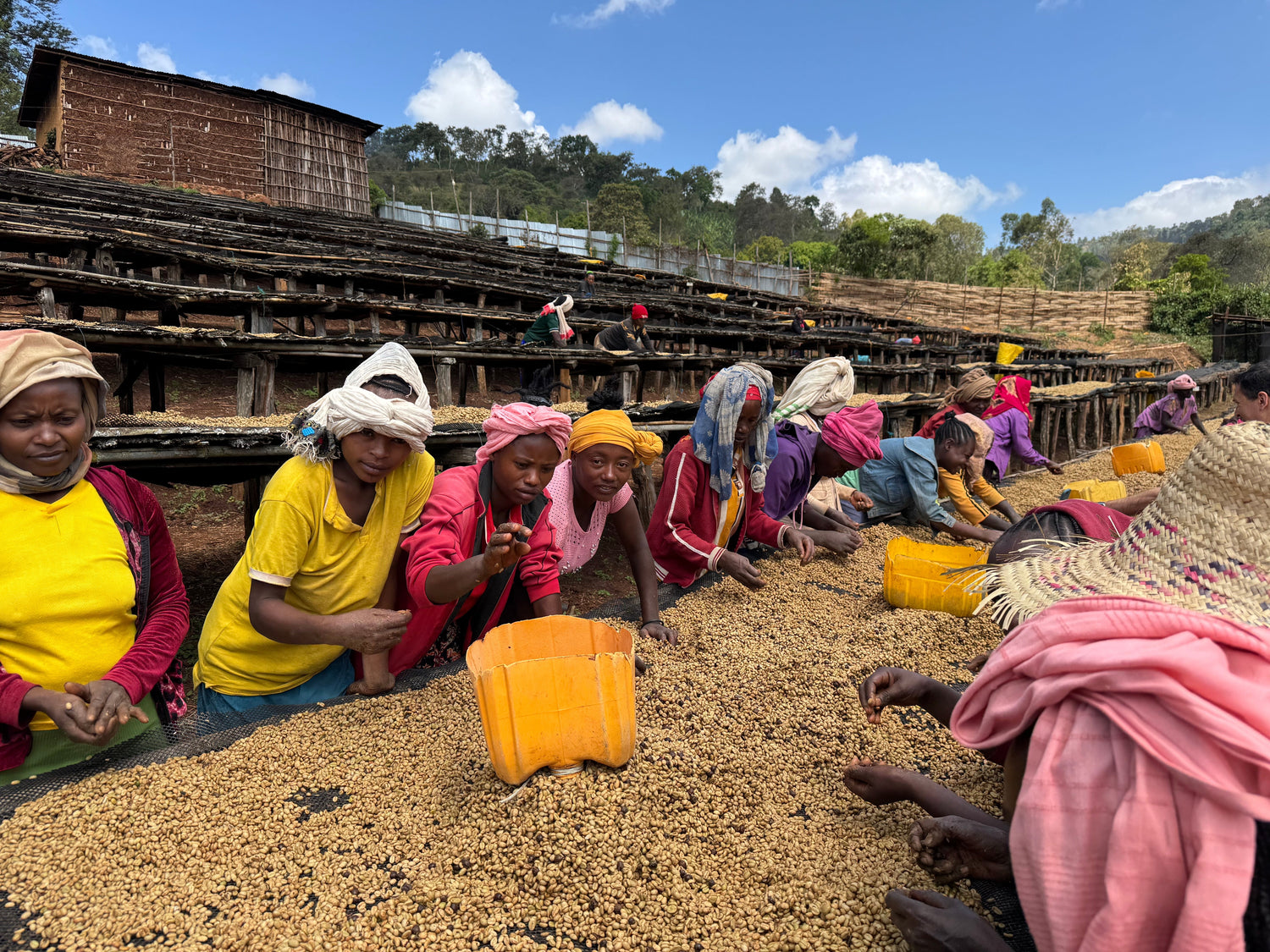
To manage the harvest - which is entirely hand-picked, and condensed into a roughly six week period between December and January - Tesfaye employs 2,000 seasonal staff, many of whom travel from more densely populated areas of Sidama, located to the north. (Ethiopia's ethnic, cultural, and linguistic diversity is staggering, and although English and Amharic are spoken widely throughout Ethiopia, many of Tesfaye's pickers must travel across traditional cultural and language borders.)
While there is a history of coffee cultivation in Guji, the more established growing areas are in Uraga, further north and west. In practice, this has led to the emergence of larger farms near Shakisso, but it has also meant that the mix of varieties cultivated is well identified here (compared to the "mixed landrace" or "heirloom" classification you tend to see in regions like Yirgachefe or Sidama). Suke Quto grows two varieties, kurume and wolisho, that still demonstrate significant heterogeneity from plant to plant, but can be clearly identified on the farm. One of Tesfaye's many contributions to his community is his discovery that the two varieties usually have higher quality when grown and harvested together.
Suke Quto is entirely organic - not by intent, but as a result of Tesfaye's commitment to nature. Falling trees and plant matter are allowed to decay without intervention, covering the entire farm in rich organic matter. A prominent feature of the farm even 25 years later is the continued presence of scorched trunks and roots of wildfire-impacted trees. (Tesfaye attributes their longevity to the high elevation, which results in dense wood that decomposes extremely slowly.) Much of the farm has been reforested, but many original trees more than 50 years old still remain, including some of the namesake "suke" and "quto" trees.
For someone who claims to care more about the trees than the coffee, Tesfaye's picking and processing standards are immaculate. Staff are only allowed to pick during the mid-day hours when the plants are more supple (giving ripe coffee more easily and without concern for branches breaking). Coffee fruits with more mucilage - which is largely associated with adequate rainfall - are processed as washed coffees because the mucilage contains sufficient sugar to feed the microbes responsible for fermentation. This fermentation occurs while the depulped coffee is submerged in water, and it usually takes between 60-72 hours. Fermentation is deemed complete when the coffee has lost its slippery, sticky texture. From there the resulting parchment coffee is washed and moved to raised drying platforms where it dries within a maximum period of 13 days, covered in mesh nets to prevent overheating during the highest hours of sun.
Visiting Suke Quto is a transformative experience - the farm's temperatures are cooler, its soil and air have more moisture, and its wildlife are more abundant than in the surrounding areas - where deforestation and frequent gold mining have left the rivers polluted and the environment incredibly hot, dry, and dusty.
Asked if there is anything he would like our staff and customers to understand about his farm, Tesfaye shared, "Everything I do, I do for nature. And when you buy coffee from Suke Quto, you are preserving nature."
With gratitude to Tesfaye and to our sourcing partners at Trabocca, we couldn't be more excited to share this special coffee on our single origin menu. With a lighter roast but a very well-balanced profile, this coffee will be a delight in any brewing method, from espresso to auto-drip to V60 and beyond.
We're thrilled to share that this coffee was selected as a finalist in the 2026 Good Food Awards.
"The Good Food Foundation exists to celebrate, connect, empower, and leverage the passionate and engaged, but often overlooked, players in the food system who are driving towards tasty, authentic, and responsible food in order to humanize and reform our American food culture." (goodfoodfdn.org, opens in a new tab)
The Good Food Awards, opens in a new tab recognizes products that are exceptional not just for craftsmanship and flavor, but for social and environmental sustainability as well. As part of the submission process we shared information about Suke Quto's sustainability and labor practices—as well as initiatives that we are taking to build a more sustainable operation, like donating our used jute bags to local farms who use them as biodegradable weed barriers. We're thrilled to be members of the Good Food community and even more honored to represent Tesfaye's conservation efforts in this capacity.
Ready for a cup of excellence?
TASTING NOTES
Peach, Caramel, Orange Blossom
ROAST LEVEL
Light
PROCESS
Washed
VARIETIES
Kurume & Wolisho
REGION
Odo Shakiso, Guji, Oromia
ELEVATION
2,000-2,200 masl
PRODUCER
Tesfaye Bekele
SOURCE
Suke Quto Farm



Leave a comment
This site is protected by hCaptcha and the hCaptcha Privacy Policy and Terms of Service apply.