

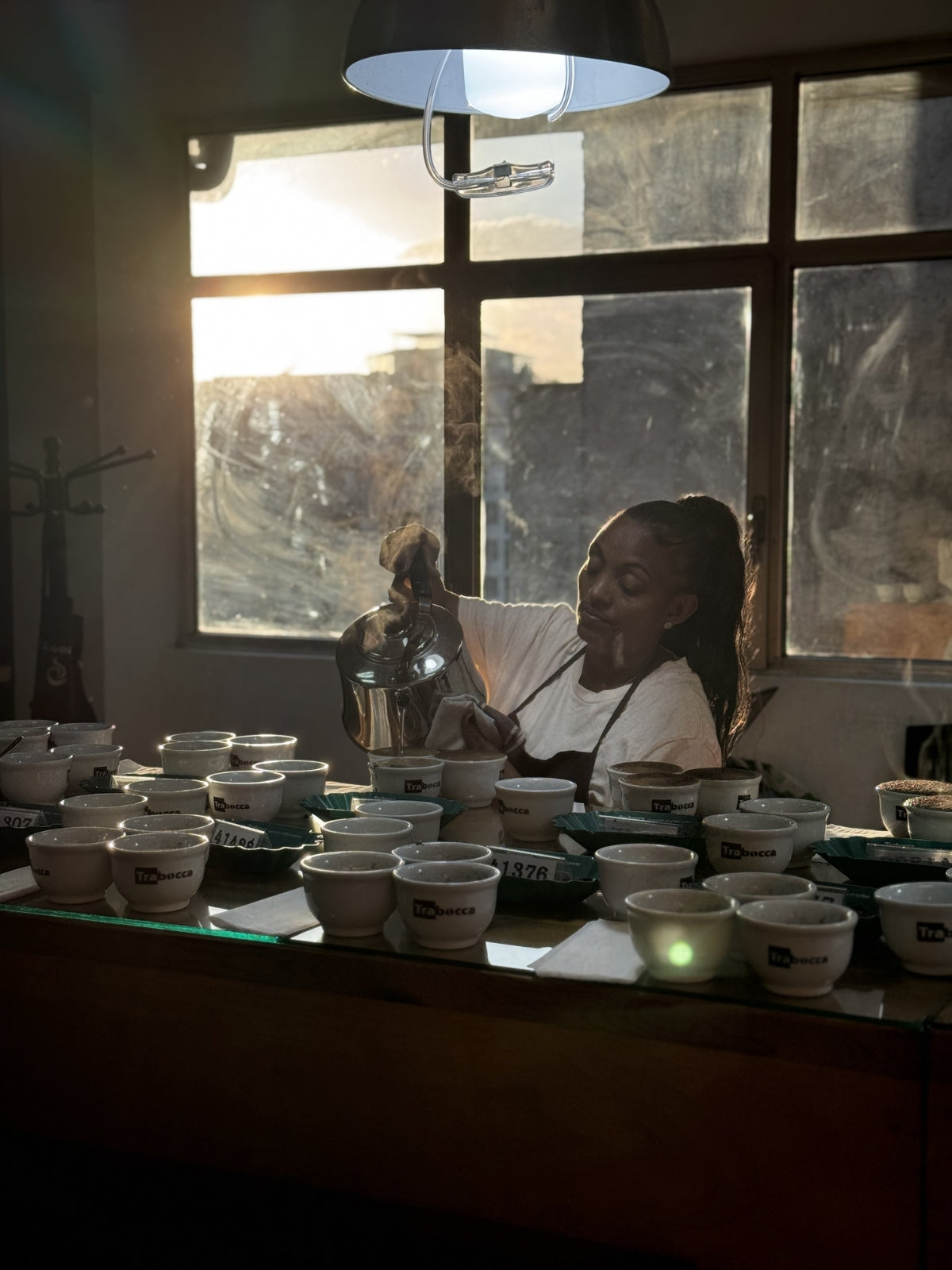
Aside from coffee recommendations and brewing suggestions, some of the top questions we receive are related to a coffee's sourcing and origin relationships. Our team enjoys these questions because these topics are the exact focuses we have in all aspects relating to sustainability, sharing enjoyable coffees, improving quality, and celebrating the people behind the coffee.
In this article, Sam, our Green Coffee Buyer, expands on what these practices mean to Partners Coffee and provides insight into what drives our sourcing processes: Relationship Coffee.
WHAT IS RELATIONSHIP COFFEE?
Our objective is to source coffee from the same producers year after year. On the surface that seems like a simple proposition: once we identify a farm or community whose coffee we like, we commit to regularly buying it, as long as we can agree to mutually workable prices each year.
In practice, sourcing all of the coffee we need each year is a substantial task involving thousands of individual producers across a dozen countries. Coordinating all of this requires a lot of collaboration - with importers, exporters, and community sourcing partners, who collectively ensure that the coffees we want are purchased from farmers, processed and milled according to our expectations, built into larger format lots as required, and then shipped and financed.
In the last twenty years “Direct Trade” has become a popular term, and while it could fairly describe most of our sourcing, it doesn’t necessarily reflect all of that essential work that happens between the farm and our roastery.
We’ve come to prefer the term “Relationship Coffee,” signifying our commitment not just to individual farmers and their communities, but to all of our sourcing partners along the way.

HOW DO YOU EVALUATE NEW SUPPLY NETWORKS?
Naturally we focus on maintaining and growing existing relationships rather than establishing new ones. When considering a new supplier, I look for indications that the farmer, cooperative, or exporter will be a logical addition to our supply networks. Do their coffees fulfill a durable, unmet need on our menu? Can we expect consistent quality and availability year after year? Could sourcing from a new supplier negatively impact an existing relationship?
Cultivar Coffees, opens in a new tab, our sourcing and export partner in Peru for the last four years, is an excellent example of a newer relationship that we’re proud of. We are essentially their first customers in the United States, so working with them required significant planning. For many years we weren’t buying coffees from Peru, but it struck me as a logical origin for expansion. Peru produces large volumes of good quality washed coffees that could work well in our mainstays, but due to its location south of the equator, it harvests on a totally different timeline than Central America. To us that’s beneficial for quality and logistics because it provides a source of fresh, versatile coffees in the winter months. It’s also beneficial for pricing - a more seasonal menu means less money spent storing and financing the same coffees year round.
In our search for a Peruvian supplier we were introduced to Cultivar by another longtime supplier of ours in Guatemala who suggested that they would make a good, values-aligned fit. Prior to working together we tasted samples to identify regions and profiles that might work for us. Because the harvest in Peru had already finished, we had to wait more than six months to taste coffees that were actually available for sale - but, to our delight, we found that we preferred coffees from the same regions and individual producers. All together it took about a year of conversation and planning before fresh crop Peruvian coffees had arrived in our warehouse, but we’re that much more confident in those supply chains due to the intentionality of our approach.

How does sourcing for blend components compare to sourcing single origin coffees?
For sustainability purposes, we try to source both single origin and blend components through the same supply chains. We have seen that price incentives for excellent coffees can meaningfully benefit farmers, but the reality is that every farm produces a spectrum of different qualities. This is true at the community level, too: the best coffee producer in the world might be neighbors with someone who is more focused on yields than on quality, or whose farm is at a lower elevation, or who faced challenges drying the coffee this harvest. Microlots do enrich some farmers, but it’s important that markets have space for farmers to tender more generic qualities too. Those coffees might not make for a particularly interesting single origin coffee, but work perfectly well in a bigger format blend.
Aside from quality, we don’t put strict constraints on what constitutes a single origin coffee. Typically I like to select lots that I think represent origin, agricultural aptitude, and variety well. Sometimes we’ll even combine a few tiny lots from the same community if we think it makes sense to compile them under one name. (This is something we do especially often in Colombia, where we’ll see very small quantities - too small to sell individually - of coffees produced by siblings or cousins with neighboring farms.)
Coffees in East Africa are almost entirely produced as community lots - individual deliveries are practically inseparable due to size and scaling constraints - but in the Americas, the majority of coffees we offer as single origins are single farm, single variety selections.

What is your approach to roasting a new coffee?
Typically for our seasonal offerings, there will be qualities that I liked in the sample or that I liked in past harvests that I want to preserve or emphasize. This can be a bit of a balancing act, because there’s a very narrow window near the end of a roast where everything will be in balance, particularly for lighter roasts.
When trialing a new coffee we usually take reference data from the most similar coffee we can find—ideally of the same coffee from a previous harvest, but if not, then something with a similar origin, processing style, and variety. During the roast we can manipulate the timing and intensity of our heat and airflow, and we’ll make small adjustments based on physical changes happening in the coffee, which are usually color cues. Once we’re done with the trial batch we’ll set it aside for tasting & repeat as needed until we’re happy with the results.
Water can make a massive difference in how coffee tastes, so we always evaluate new coffees using filtered, New York City municipal water - what each of our cafes is using along with many of our wholesale partners. Our water in Brooklyn is soft and slightly alkaline, which is why the tasting notes might differ very slightly if you’re located somewhere else!

What are some misconceptions about coffee production?
Recently I’ve been thinking about the massive amount of time that coffee production requires, which is a bit challenging to conceptualize when we’re simultaneously encouraging people to drink and to serve freshly roasted, freshly ground, freshly brewed coffee.
If you planted a coffee seedling today, it would take about three years for that tree to bear any fruit. More like five to seven years to become significantly productive. Then you can expect 1-2 pounds of finished green coffee per year, about as much as I personally consume in a week. Coffee trees are susceptible to hot temperatures, cold temperatures, and disease, so if anything happens - two hours of frost exposure, or an outbreak of coffee leaf rust - you’ll need to start over. Five years of waiting to get that productivity back.
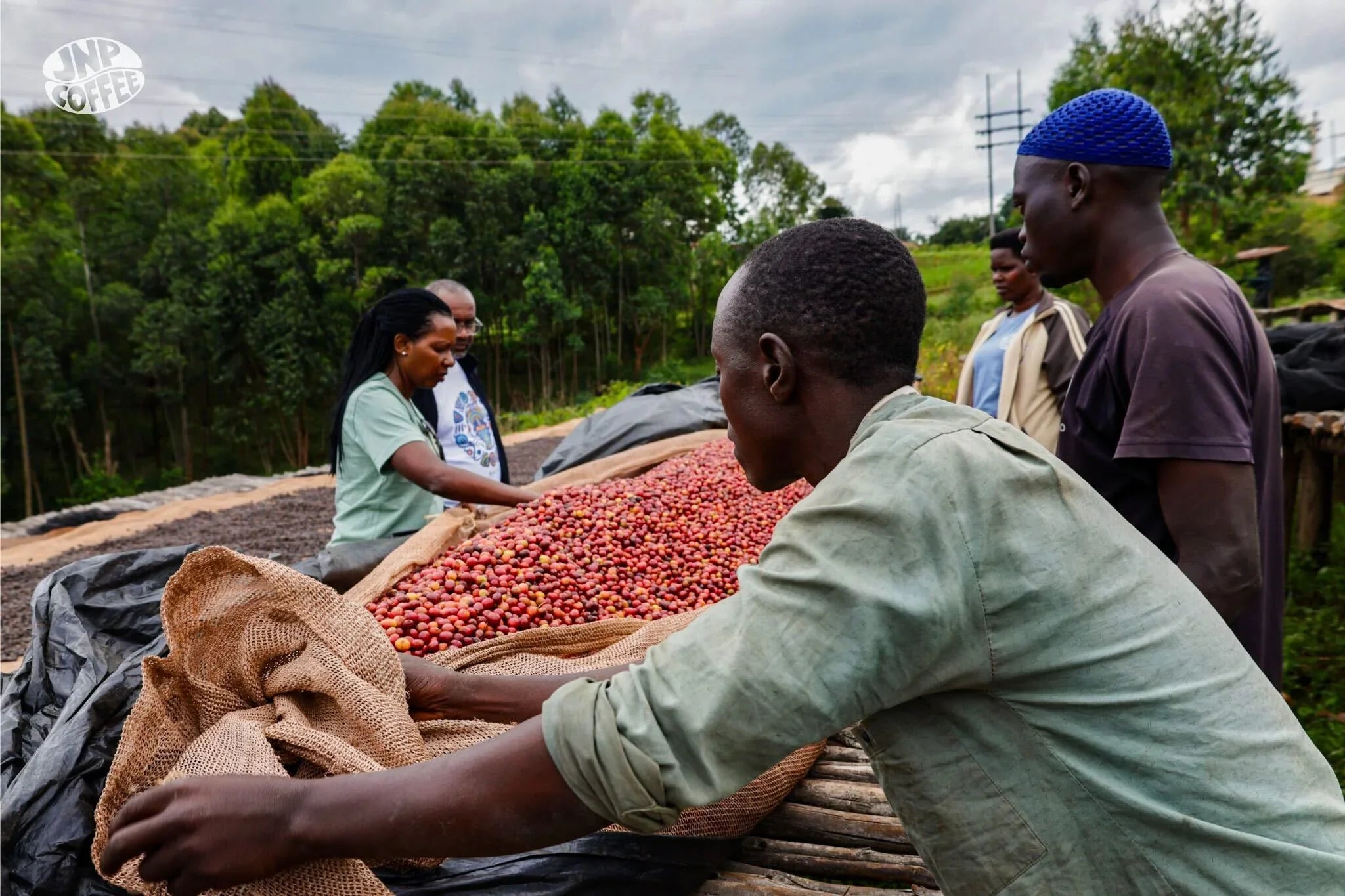
Once you harvest the coffee there are a number of things that need to happen. The coffee, still a freshly picked fruit, must be processed and dried. This takes weeks. It has to be tasted, either separated or blended, warehoused, milled, tasted again, sold, containerized, and shipped. This takes months. (There is, for the record, such a thing as excessively fresh coffee - this period of postharvest “rest” almost always benefits coffee quality.)
Meanwhile it's normal for a roaster to release a new coffee from the last harvest, perfectly on time, while simultaneously tasting and selecting coffee from the same farm from their current harvest, even as the fruits that will become the next harvest are already on the tree. That's three years of harvests, three years of somebody's income, in different stages of progress at once.
All of this - combined with a market that’s not necessarily tethered to the cost of production - makes coffee production extremely vulnerable to risk, particularly when prices drop so low that upkeep becomes difficult. Prices appear unusually high in 2026, but if you look at it under a broader scope, trees that are finally becoming productive today were planted when the commodity market was under $1/lb - below the cost of production for almost any farmer, even in Brazil!
Have questions? Need assistance?
Send an email to our team at hello@partnerscoffee.com.

Leave a comment
This site is protected by hCaptcha and the hCaptcha Privacy Policy and Terms of Service apply.