

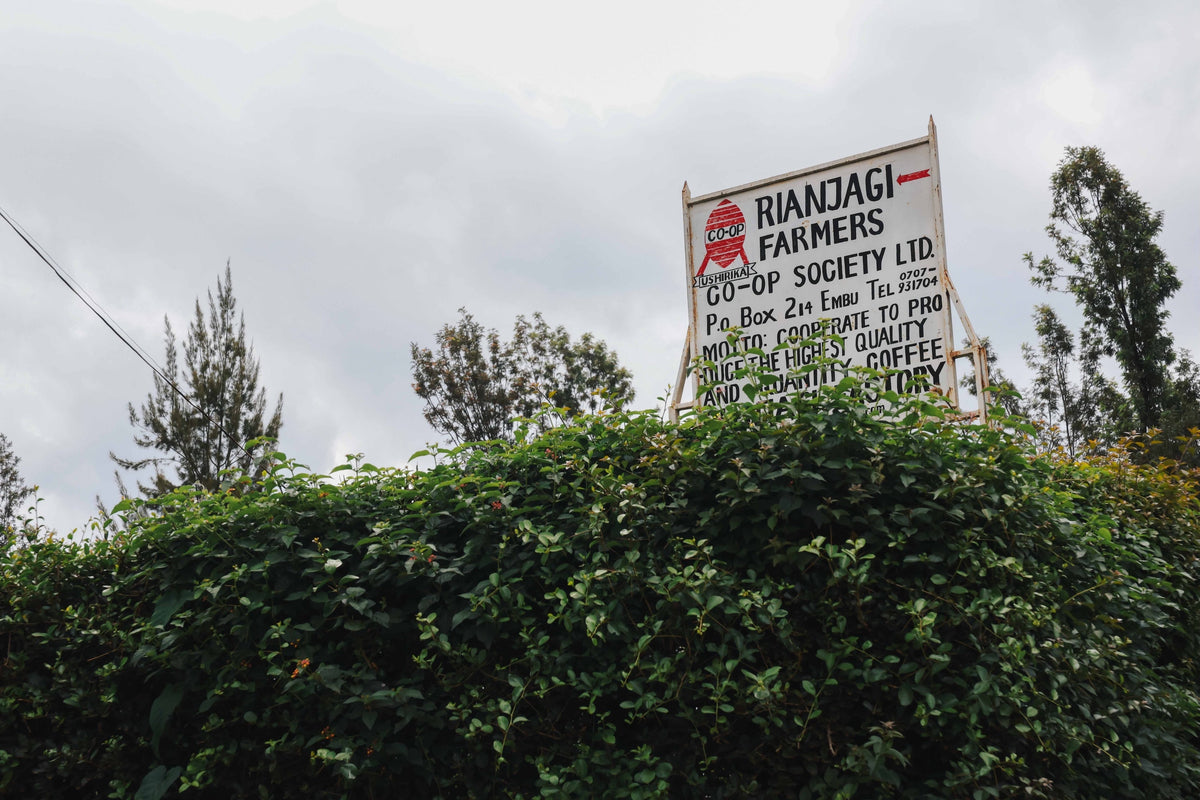
The Rianjagi Factory is located in Embu County on the southeastern side of Mt. Kenya. The factory, as washing stations are known in Kenya, belongs to the Rianjagi Farmer’s Cooperative Society, whose membership consists of more than 2,500 local farmers.
Farms here are incredibly small in scale, with plots averaging less than a quarter of a hectare. Coffee here grows alongside tea, subsistence crops, and shade trees, which frequently include avocados, macadamias, and mangoes.
Rianjagi's farmers cultivate mostly SL-28 and SL-34, varieties developed by Scott Labs in the 1930s specifically to succeed in Kenya's climate. Because SL-28 and SL-34 are susceptible to coffee leaf rust and coffee berry disease, farmers here also grow some Batian and Ruiru 11, newer, disease-resistant cultivars developed through selective cross breeding of several other varieties including both common SLs and the Timor hybrids.
Rianjagi processes its coffee with a traditional fully washed method (as opposed to the famous Kenyan "double soak" or "double fermentation," which was developed to manage production bottlenecks in the days of yore). Farmers deliver their pickings to the factory, and that evening, the coffee is depulped and fermented without water for up to 24 hours. After fermentation the coffee is moved to elongated washing channels where water is used to rinse the coffee of its mucilage and then to sort the coffee by density. Factory workers agitate the coffee during the washing process to ensure all of the mucilage is removed, ensuring a clean and high clarity cup.
After washing the resulting parchment coffee is laid on raised mesh platforms to dry. The platforms are covered by a shade net, enabling the coffee to dry slowly without excessive exposure to intense ultraviolet light.
A short history of coffee production in Kenya
Coffee was introduced to Kenya in the 1890s, but its production didn't begin at scale until several decades later. Its commercialization was largely shaped by British colonial exploits, and initially, only white settlers were allowed to grow coffee, with a just few limited exceptions in Embu, Kisii, and Meru counties. This would change in the aftermath of the Second World War, motivated by the British government's efforts to repair their domestic economy and a growing Kenyan frustration with land dispossession. The colonial government responded with the "Swynnerton Plan" of 1954, which privatized communal land and introduced a series of policies designed to promote cash crop smallholdings, spurring a period of early growth in Kenya's coffee sector.
Smallholder coffee production continued to grow following Kenya's declaration of independence in 1963. There was initial tension over new plantings - Kenya was already at risk of exceeding export quotas established by the International Coffee Agreement of 1962, and more production threatened the profitability of the powerful European-owned estates. Still, by the end of the 1960s, the majority of Kenya's coffee was already grown by smallholder farmers. This era saw the proliferation of Farmers' Cooperative Societies, whose primary function was to facilitate the collection and processing of their members' coffees.
While smallholder, cooperative style coffee was expanding, postcolonial power was consolidating around Kenya's coffee export mechanisms. Factories and cooperative societies were legally required to use a middleman known as a "marketing agent," whose job was to present their coffees to the newly established Nairobi Coffee Exchange for auction. Exporters would purchase their coffees through the exchange, then sell the coffee to importers in consuming countries.
But under this system, the marketing agent was almost always bankrolled by a multinational company which also happened to own the dry mill, exporter, and importer. The auction system worked well for price discovery - it would reward higher prices to higher cup quality in a consistent and straightforward way - but it was structured in such a way that siloed farmers from the market value of their coffee. Once a marketing agent retained their percentage of the sale, and the cooperative deducted their share of the costs, the price paid to farmers might still be below their cost of production, even for coffees commanding very high prices. (To complicate this further, it was - and remains today - practically impossible to connect the quality or value of a coffee with the efforts of any individual farmer when several dozen farms contribute to even the smallest lots.)
This structure began to change in 2006 with the introduction of the "second window," a scheme to allow direct sales between the marketing agent and an international buyer. Prices for certain qualities were still benchmarked by the auction, but sales could be negotiated outside of it. In 2023, the Kenyan government digitalized the Nairobi Coffee Exchange and fully liberalized coffee sales, eliminating marketing agents entirely. The new regulations also codified something known as the Direct Settlement System, requiring buyers to pay sellers within 5 business days - a dramatic improvement from the old system, in which funds might not be paid out for months after harvest, complicating finances and creating high interest credit dependency for farmers.
Kenya's coffee production has been in decline for the last few decades, owing in part to the challenge of growing coffee profitably, in part to climate change, and in part to the rapid urbanization of formerly agricultural areas around Nairobi. Today a sprawling metropolis, Nairobi's population has increased fivefold since 1980, while Kenya's total coffee exports have shrank to just a third of what they were then. While there is a common sentiment in the specialty coffee industry grieving Kenya's decline as a coffee origin, we're actually quite optimistic for its bright future, with these regulatory changes opening the door to direct trade relationships and greater producer empowerment.
Rockbern Coffee
Founded by Peter Muchiri, a third-generation coffee producer, Rockbern Coffee is one of the newer and most promising exporters taking advantage of the liberalization of Kenya's coffee sector. With a farmer's perspective, but the experience necessary to understand and communicate international buyers' needs, Peter and Rockbern have been quick to capitalize on the opportunity to connect producers and roasters in a direct, mutually sustainable way.
We were connected with Peter, with Rockbern, and with the Rianjagi cooperative through our import partners, Trabocca, who also assist our sourcing in Ethiopia. Trabocca began working in Kenya in 2018, wanting to establish a direct relationship with farmers supported by a trustworthy local partner who could facilitate milling, export, and quality control. We were fortunate to visit Kenya with Trabocca in late 2025, and we're thrilled to see our first purchase with Rockbern land.
Ready for a cup of excellence?
TASTING NOTES
Blackberry, Clementine, Golden Raisin
ROAST LEVEL
Light
PROCESS
Washed
VARIETIES
SL-28, SL-34, Batian, & Ruiru 11
REGION
Embu County
ELEVATION
1,600-1,700 masl
PRODUCER
Rianjagi Farmer’s Cooperative Society
SOURCE
Rianjagi Factory


Leave a comment
This site is protected by hCaptcha and the hCaptcha Privacy Policy and Terms of Service apply.