

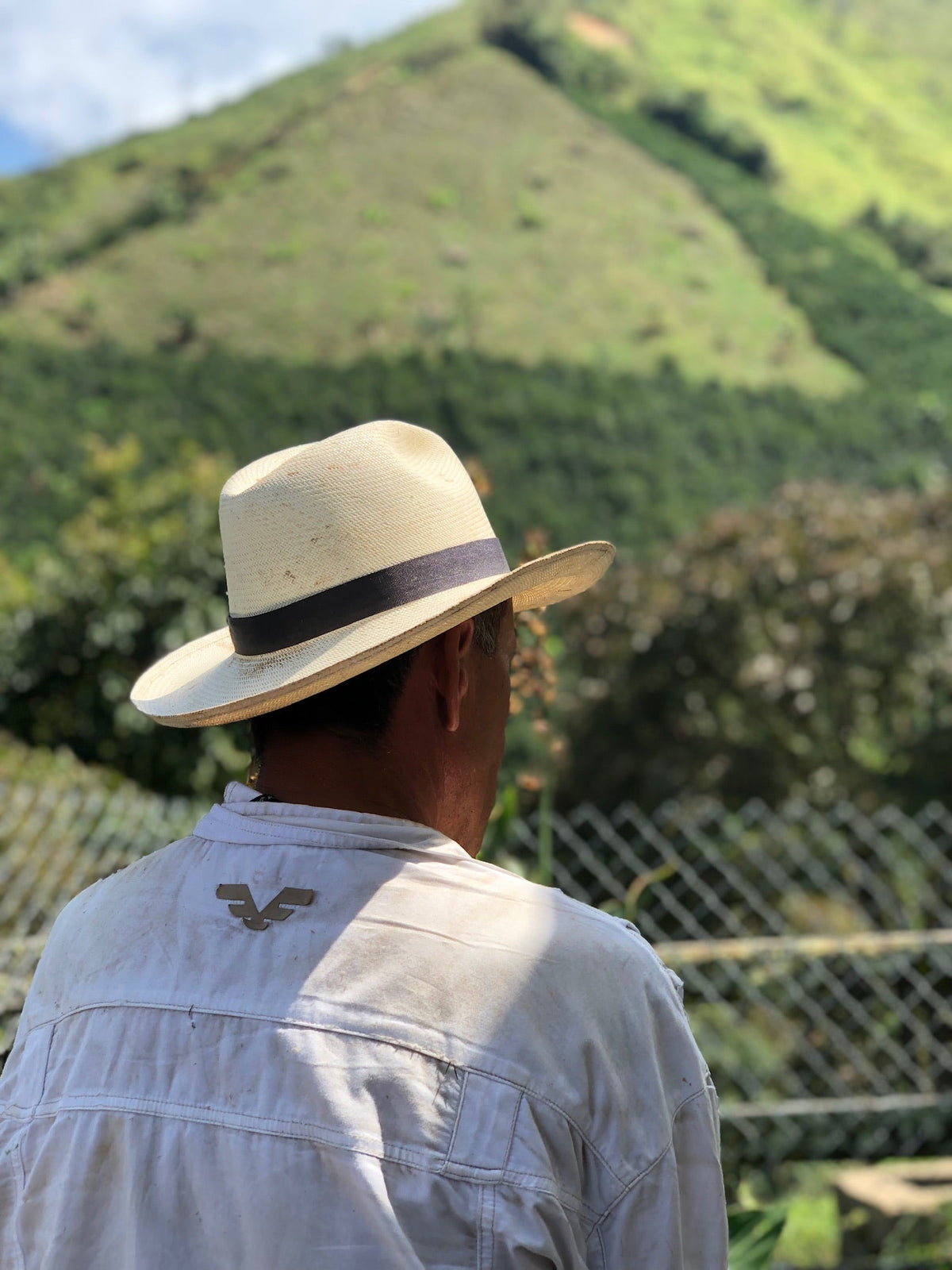
We first tasted coffee from Don Rubén in 2015 while visiting Pergamino, now our longtime suppliers in Colombia. His was an immediate standout on the cupping table, a coffee simply too good to direct to a bigger volume community lot. Since then, we have bought every subsequent harvest offered to us, totaling nearly 20 due to the biennial production cycle in this part of Colombia.
As a younger man, Rubén worked as a jornalero, or day laborer, traveling to farms all over Antioquia picking coffee and performing other manual work. After 20 years, he had finally saved enough money to buy a plot of land in an area called El Noque, near the town of Caicedo. Initially people cautioned him that coffee would not grow in this location - reaching 2,100 meters, the farm was thought to be too high and the climate too cold. And while these conditions can certainly pose a challenge for productivity, the quality of the coffee he planted proved to be spectacular.
Rubén lives on the farm with his wife, Rosa Eleny, and son, Juan Gregorio. They call the farm Finca El Faldón, named “the skirt” for the shape of the two mountain ridges that frame the two-hectare plot and homestead. While not especially far from town, the farm is also not particularly easy to access, with mudslides occasionally blocking the path to the main road. When we first visited Rubén, the farm was only accessible by an hour long hike, and coffee was transported back down the mountain strapped to the back of a borrowed mule.
On that first visit, Rubén expressed his desire for un cliente, a dedicated customer willing to commit to regular purchasing year after year - thereby offering the farm some security against the volatility of the open market. Since our first purchases, Rubén has been able to make significant reinvestments in the farm (and indulge in what he calls "little pleasures"). With his premiums, he has built new parabolic drying tunnels, renovated the homestead with new patio tiling and a modern kitchen, and built a road to enable direct access to El Noque. More recently, to diversify his income after a few years of challenging harvests, he also acquired real estate to offer for rent in Caicedo town.
Today Rubén acts as a sort of community liaison for around 20 neighboring producers who also sell coffee to Pergamino - their combined production becomes the core component of El Ramo. Proud to support his neighbors in their coffee production, he has recently constructed a system that helps transport pickings more safely and efficiently down the very steep slopes of El Noque, using water and gravity to transport coffee fruits through hundreds of meters of PVC pipe.
Caicedo and the nearby community of Urrao are well isolated by the mountains, and producers are often more conservative in farm management practices compared to elsewhere in Colombia. For these reasons, there has been less motivation to plant new varieties - whether the rust resistant cultivars promoted by the National Federation of Coffee Producers or the the novel specialty varieties popular further south.
In Caicedo, this means that Caturra and Bourbon still dominate production. Both varieties have superb potential for quality, and though susceptible to coffee leaf rust, it is less pervasive here due to the remote location and cold temperatures.
In Urrao, on the other hand, another variety called Chiroso has emerged. First believed to be a natural mutation of Caturra, it is now thought to be from a distinct lineage that has more in common with Ethiopian landrace varieties. The plants are usually compact, like Caturra, have elongated seeds, and most importantly are very well adapted to Urrao’s cool climate. Although the classic profile is getting more and more challenging to find, the best Chiroso coffees are transcendent - floral and fruited, like Gesha, but syrupy-sweet rather than tea-like.
Recently Rubén has started planting Chiroso of his own. Because the plants are still young, their production remains small, but this lot contains some of his first Chiroso harvested alongside his best quality Bourbon of the season.
Rubén follows a picking and processing regimen that is traditional for this part of Antioquia and suits its climate rather spectacularly. He depulps his coffee and ferments it without water in a small, stainless tank, combining multiple days of picking - with fermentation already underway, the newer pickings feed the microbes with fresh additions of sugary coffee mucilage. Having tasted many coffees processed in this way alongside a number of more controlled lots from this same region, we've come to believe that this more traditional method of processing enhances the cup with layers of complex fruit flavors.
El Faldón is a longtime favorite among our team, and as always, we're thrilled to bring this coffee back. We always enjoy it brewed with a Hario V60, but it's going to be an excellent coffee with any brewing method, including auto-drip and espresso.
Ready for a cup of excellence?
TASTING NOTES
Peach, Orange, Mango
ROAST LEVEL
Light
PROCESS
Fully Washed & Dried On Covered Tables
VARIETIES
Bourbon & Chiroso
REGION
El Noque, Caicedo, Antioquia
ELEVATION
2,100 masl
PRODUCERS
Rubén Dario Gómez & Rosa Eleny Gómez
SOURCE
Finca El Faldón

Leave a comment
This site is protected by hCaptcha and the hCaptcha Privacy Policy and Terms of Service apply.